

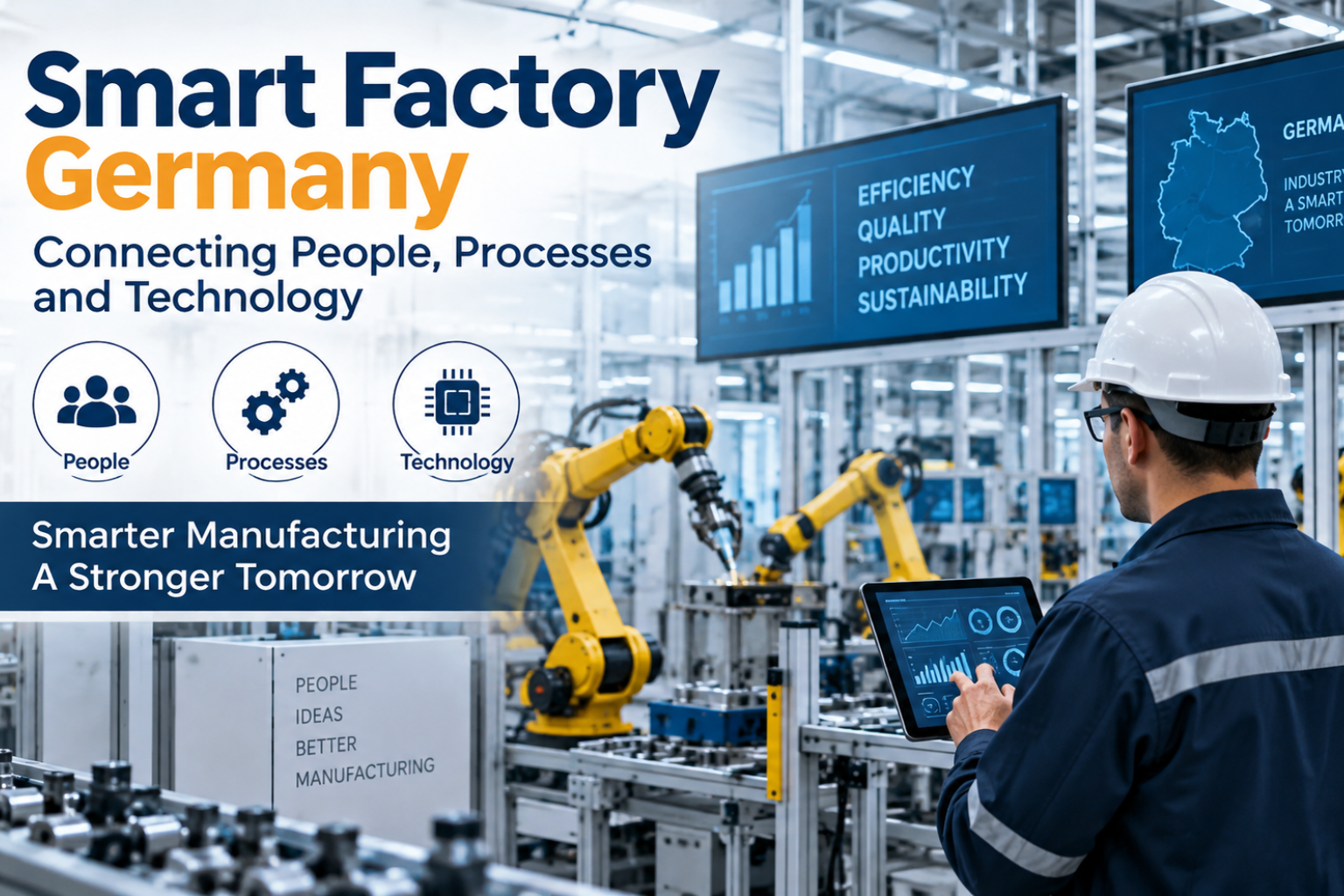
Manufacturing is becoming increasingly connected. Machines generate data, production systems communicate with each other, dashboards provide real-time visibility, and artificial intelligence is beginning to support complex operational decisions. In Germany, where manufacturing remains closely associated with engineering, precision and continuous improvement, these developments are accelerating the move towards smarter factories.
But building a successful smart factory is not simply a matter of installing more technology.
A truly effective Smart Factory Germany approach brings together three elements that must work as one: people, processes and technology. When these elements are disconnected, even sophisticated digital systems can struggle to deliver meaningful improvements.
Why Smart Factories Need More Than Technology
Modern factories can collect enormous amounts of operational information. Sensors monitor machines, ERP systems manage resources, MES solutions track production and digital dashboards display performance indicators.
However, information by itself does not improve production.
A factory may have an impressive dashboard showing downtime, OEE, quality losses and delivery performance, yet recurring problems can remain unresolved if nobody owns the response. This creates an important distinction:
Data creates visibility. People and processes turn visibility into action. A successful smart factory therefore needs a management system that connects digital information with everyday operational behaviour.
Connecting People With Digital Manufacturing
Technology should support employees rather than create another layer of complexity.
Operators, maintenance teams, engineers, supervisors and managers all interact with manufacturing processes differently. A useful digital environment should help each group understand what matters, what has changed and what action is required.
For example, an unexpected equipment stoppage should not simply appear as another number on a dashboard. The information should trigger a structured response involving the appropriate people.
This can involve:
- Identifying the immediate cause of the loss
- Assigning responsibility for investigation
- Conducting structured root-cause analysis
- Defining corrective actions
- Tracking completion
- Verifying whether the solution actually worked
- Standardising successful improvements
This human connection is particularly important as manufacturing moves from Industry 4.0 towards Industry 5.0, where technology and human capabilities increasingly need to complement each other.
Processes Provide the Structure
Technology can expose a problem, but a clearly defined process determines what happens next.
This is why Lean Management remains relevant within smart manufacturing environments. Lean principles provide a structured way to identify waste, investigate problems and continuously improve operations.
A smart factory can benefit from clearly defined processes for:
Performance Management
Teams need agreed KPIs, clear ownership and regular performance reviews.
Problem Solving
Recurring losses require root-cause investigation rather than repeated short-term fixes.
Daily Management
Teams need routines that turn performance information into timely decisions.
Maintenance
Equipment reliability depends on disciplined preventive and autonomous maintenance activities.
Continuous Improvement
Improvement ideas should be prioritised, assigned, implemented and verified.
When these processes are clearly established, technology becomes much more useful because employees understand how to act on the information they receive.
From KPIs to Real Action
One of the biggest challenges in digital manufacturing is the gap between measurement and execution.
A company might monitor:
- OEE
- Downtime
- Scrap
- First Pass Yield
- Maintenance performance
- On-time delivery
- Safety indicators
Yet the presence of these KPIs does not automatically improve them.
The important question is: What happens when a KPI moves outside its expected range?
A stronger management approach creates a closed loop:
Data → Visibility → Ownership → Action → Verification → Improvement
This approach transforms a dashboard from a reporting tool into part of the operational management process.
Why People, Processes and Technology Must Work Together
Consider a factory experiencing repeated machine breakdowns.
Technology can identify when the machine stops. A digital maintenance system can record the event. Analytics may even identify patterns in previous failures.
But someone still needs to investigate why the failures occur.
The organisation also needs a process for determining the root cause, implementing a countermeasure and confirming that the failure rate has actually decreased.
This illustrates the relationship between the three components:
Technology identifies.
Processes organise.
People execute.
Remove any one of these elements and the overall system becomes weaker.
How Performance Storyboard Supports Operational Execution
For organisations looking to connect digital performance information with structured execution, Performance Storyboard brings together several areas of performance and improvement management.
Its approach connects performance management with areas such as Daily Audit Management, Advanced Problem Solving, Total Maintenance Management, Small Activity Management, project management and performance management.
This is particularly relevant for organisations that already have multiple sources of operational data but want to create stronger connections between strategy, KPIs, daily management and improvement activities.
The focus is not simply on collecting more information. It is on helping organisations create a more structured path from performance information to action.
What a Connected Smart Factory Can Achieve
When people, processes and technology are properly aligned, manufacturers can work towards several practical improvements:
- Faster identification of operational problems
- Clearer accountability for performance
- More consistent daily management
- Better equipment reliability
- Stronger cross-functional collaboration
- More structured problem solving
- Improved visibility across operations
- Faster follow-up of improvement actions
- Better alignment between strategic goals and shopfloor activity
The objective is not to make every process digital simply because digital tools are available.
The objective is to use technology where it helps people make better decisions and execute processes more consistently.
The Future of Smart Factory Germany
The next generation of manufacturing will not be defined by connected machines alone. AI, automation, IoT, analytics and digital management systems will continue to develop, but their value will depend heavily on how organisations use them.
A smart factory should therefore be viewed as an operating model rather than simply a technology project.
The strongest approach combines:
- Technology for visibility and intelligent analysis
- Processes for consistency and structured execution
- People for decision-making, problem solving and improvement
This combination creates a more practical path towards operational excellence.
For manufacturers exploring how digitalisation can be connected with Lean principles and performance management, explore Performance Storyboard to understand how an integrated approach can support smarter operational execution.
Frequently Asked Questions
What is a Smart Factory in Germany?
A Smart Factory uses connected technologies, data, digital systems and structured processes to improve manufacturing performance. The concept goes beyond automation by connecting technology with people and operational management.
Why is people management important in a Smart Factory?
Employees interpret information, solve problems and implement improvements. Technology can provide data and recommendations, but human expertise remains essential for operational decision-making and continuous improvement.
How does Lean Management support a Smart Factory?
Lean Management provides methods for identifying waste, solving root causes, standardising processes and improving performance. It can help organisations turn digital information into structured improvement activities.
What technologies are used in Smart Factories?
Common technologies include IoT sensors, automation, MES, ERP systems, digital dashboards, analytics, artificial intelligence and connected maintenance systems.
Does a Smart Factory require AI?
Not necessarily. AI can support anomaly detection, prediction and decision-making, but a successful Smart Factory also depends on strong processes, clear KPIs, employee involvement and disciplined execution.
What is the difference between Industry 4.0 and a Smart Factory?
Industry 4.0 describes the broader technological transformation of manufacturing, while a Smart Factory represents an operational environment where digital technologies, people and processes work together to improve performance.
How can manufacturers get more value from factory data?
Manufacturers can create more value by connecting data with clear ownership, structured problem solving, daily management routines and follow-up actions. The goal should be to move from simply seeing problems to systematically resolving them.


