

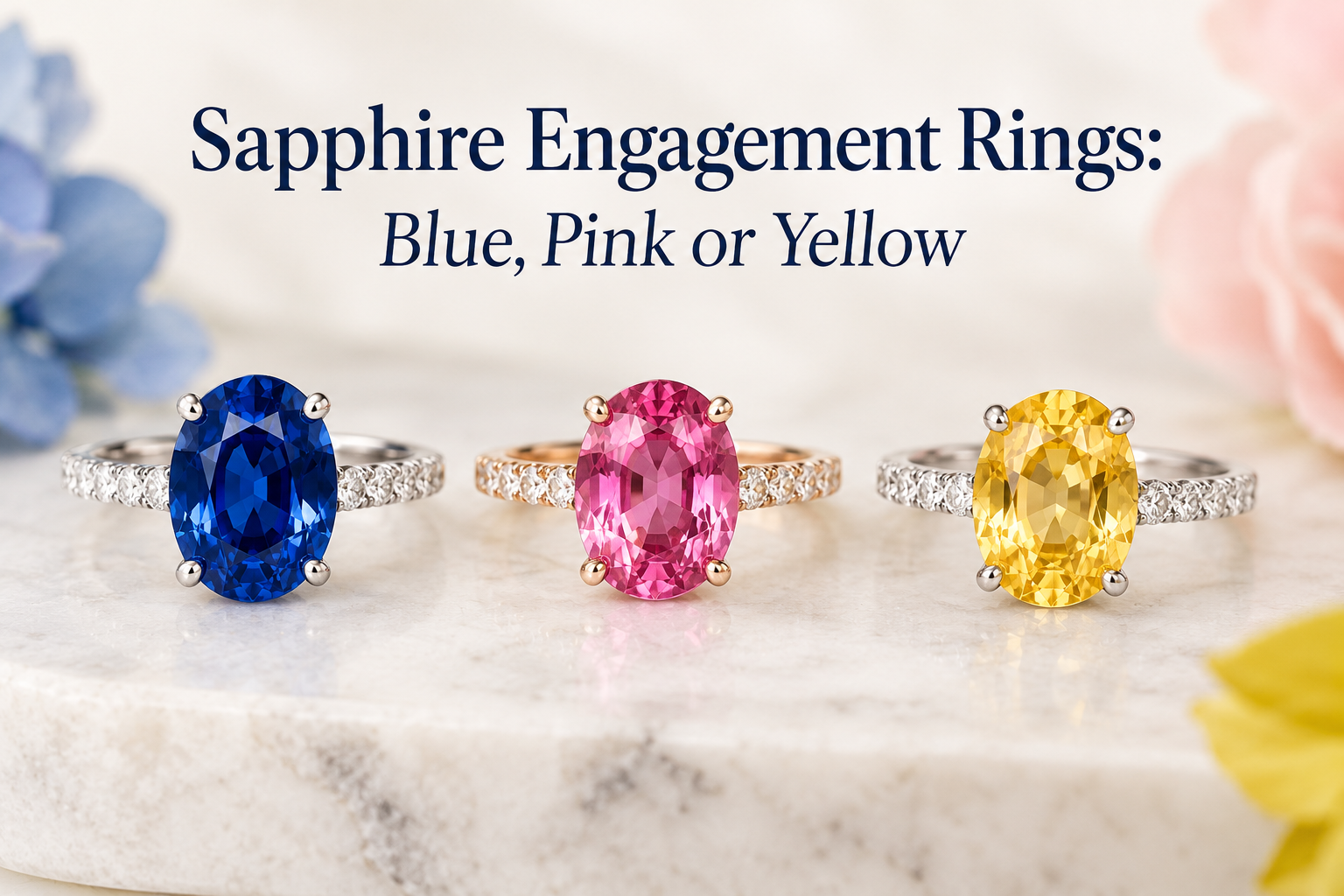
Choosing a coloured stone for an engagement ring feels bolder than picking a diamond, and it’s easy to get it wrong. Several questions can arise, such as which colour wears best? Does it matter if the sapphire was grown in a lab? Mostly, no. A sapphire is a sapphire, and lab grown engagement rings use stones with the same chemistry and hardness as mined ones. The factors that change are the price, traceability, and the way each colour behaves in daylight, on skin, and after years of wear.
This guide compares blue, pink and yellow, explains what to look for before buying, and says plainly when a natural stone is the better fit.
What Makes a Lab Grown Sapphire a “Real” Gem?
Sapphire is corundum, a crystalline form of aluminium oxide. A lab grown sapphire has the same chemical composition, crystal structure and hardness as a mined one. The only real difference is origin: it’s grown in a controlled setting rather than formed underground over millions of years. It isn’t glass, and it isn’t a simulant such as cubic zirconia.
How are the stones grown?
The French chemist Auguste Verneuil introduced the flame-fusion method in 1902, feeding powdered alumina through a hot flame to build a crystal drop by drop. Today’s producers also use flux and hydrothermal methods, which can give cleaner, more natural-looking crystals. The method matters because it leaves clues. Under magnification, flame-fusion stones can show curved growth lines, while many natural stones show fine, needle-like “silk.”
Where natural stones still win
Rarity and a story of origin are the big ones. A mined sapphire formed over geological time, and some buyers value that history above everything else. A lab can’t offer it, and if it matters to you, a natural stone is the better fit.

Which Colour Suits You: Blue, Pink or Yellow?
Blue is the classic and safest choice, pink is softer and more romantic, and yellow is the brightest and warmest. Choose by the metals you already wear, your everyday colours and how much attention you want the ring to draw. Skin tone matters less than people think. Lighting and setting matter more.
Blue sapphire
Blue gets its colour from trace amounts of iron and titanium in the crystal. The best tones sit in the middle: a vivid royal or cornflower blue that stays lively in a dim restaurant. Very dark stones can look inky indoors.
A lab grown blue sapphire can offer more consistent colour than a natural one, which often shows banding when tilted. Most buyers see that evenness as a plus, though a few prefer the slight variation of a mined stone.

Pink sapphire
Pink comes from chromium, the same element that makes ruby red. Less chromium gives pink, and more tips the stone towards ruby, so the shade you see is the best guide.
Here’s the part buyers miss: pink varies enormously, from pale blush to hot magenta. A lab grown pink sapphire in a soft shade can look almost white in a platinum setting under bright light, so judge it in daylight. It’s also far tougher than morganite, the other popular pink choice, which scores only 7.5 to 8 on the Mohs scale.
Yellow sapphire
Natural yellow sapphire owes its colour mainly to iron, while lab-grown stones reach the same warm tone through trace elements added during growth. The result is a sunny stone at a fraction of what a natural fancy yellow diamond costs.
That’s the real appeal of a lab grown yellow sapphire: colour without the diamond price tag. The catch? Very pale yellows can look weak, and if you want a ring that blends in quietly, yellow isn’t the right choice.

Are Sapphires Hard-Wearing Enough for Daily Wear?
Yes. Sapphire scores 9 on the Mohs scale, second only to diamond at 10, so it resists scratching from everyday knocks and dust. It isn’t indestructible, though. A powerful blow to an edge can still chip it, and claws wear down over time. Setting design matters as much as the stone itself.
The Mohs scale, devised by the German mineralogist Friedrich Mohs in 1812, ranks scratch resistance from 1 (talc) to 10 (diamond). Household dust contains quartz, which sits at 7, so it can’t mark a sapphire. However, the distinction between hardness and toughness often confuses people.
Here’s a mildly contrarian view. For anyone who works with their hands, lab grown engagement rings set with a 1.5-carat sapphire often make more sense than a 0.5-carat diamond at a similar budget. You can afford a protective bezel without sacrificing size. A bigger, tougher stone in a sturdy setting beats a delicate one you spend all day worrying about.
Setting and metal
A bezel wraps the stone in metal and shields its edge. Claws show more of the gem and let in more light, but they need checking. Platinum suits blue and pink stones well, while 18ct yellow gold flatters yellow sapphires. Is 9ct worth considering? For active hands, yes, because the alloy is harder, though the colour is paler and less rich.
Day-to-day care
Warm soapy water and a soft brush every few weeks are all sapphires need. Take the ring off for the gym, swimming, gardening and cleaning with bleach, which can damage the metal. Ultrasonic cleaners are usually fine for untreated stones, but ask your jeweller first. Have the claws checked once a year.
How Do You Choose a Sapphire Ring Wisely?
Judge the stone in daylight, not under shop spotlights. Examine the evenness of the colour, the quality of the cut, and the clarity, then request that the seller provide a written description of the stone, including whether it is lab-grown or natural and whether it has undergone any treatments. Finally, check the return window and sizing options before you pay.
What To Look for In the Stone
- Colour comes first. Look for an even, saturated shade with no grey or brown tint, and tilt the ring to see whether it holds up as the light changes.
- Cut comes second, and it’s the one people skip. A poorly cut sapphire has a dull, washed-out patch in the middle, often called a window, which makes even a rich colour look flat. Clarity matters less than with diamonds, since most buyers are satisfied with a stone that looks clean to the bare eye.
- Carat weight can mislead you. Sapphire is denser than diamond, so a one-carat sapphire measures slightly smaller across than a one-carat diamond. Compare millimetres, not just carats.
Implementing budget advice is straightforward. If you have, say, £1,500 to spend, put the money into cut and colour rather than chasing a higher number on the label. A well-cut 1-carat stone will beat a dull 1.5-carat stone every time.
What To Ask Before You Pay
A few questions cut through most of the confusion:
- Has the stone been treated, and how?
- Can I see a video in natural light? A lab grown pink sapphire can swing from peach to magenta depending on the bulb overhead.
- What’s the return window, and does it cover resizing?
- Can I get a matching stone if I want a wedding band later?
Frequently Asked Questions
Is a lab grown blue sapphire cheaper than a natural one?
Typically, lab grown blue sapphire engagement rings are less expensive than natural ones, often by a significant margin for stones of similar size and colour. Price in £ depends on carat weight, colour saturation and cut. A natural, untreated stone with a rich history sits at the top end. Lab-grown costs less because supply is controlled, not because the material is inferior.
Is a lab-grown yellow sapphire a viable alternative to a yellow diamond?
For colour and budget, yes. Sapphire is tough enough for daily wear at 9 on the Mohs scale. It won’t match a diamond’s fire, though, because sapphire’s sparkle is softer and glassier. If maximum brilliance is your priority, a diamond is the better fit.
Can you tell a lab grown sapphire from a natural one by eye?
No. Even experienced jewellers usually need magnification, and sometimes specialist testing, to be sure. That’s why a clear written description from the seller matters far more than any claim about how a stone looks.
Do lab grown sapphires hold their value?
Generally not. The resale market is small, so treat the ring as something to wear and enjoy. Think of it like a good watch or a well-made coat: you pay for years of use and pleasure, not for a return on the price you paid.
Summing up
To sum up, blue, pink and yellow sapphires all give you a genuinely tough, durable gemstone, and lab grown engagement rings in any of the three can be a sensible, well-priced choice. Blue is the safe classic, pink rewards careful viewing in daylight, and yellow offers warmth without a diamond’s price.
Natural stones still win on origin and resale, and a lab grown stone isn’t right for anyone who wants either. Whatever you choose, put cut and colour ahead of carat weight, and insist on a clear written description. The best colour is simply the one you’ll still enjoy seeing on your hand in ten years.


