

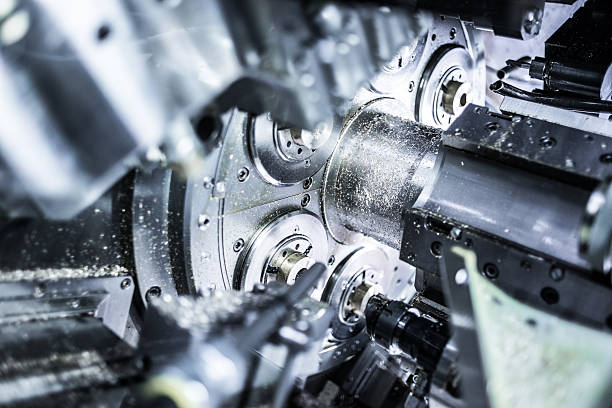
Production costs have a tendency to rise. A change in material or longer time on the machine will mean the originally competitive part is not much of a deal. How do you cut the costs without harming the tolerances, surface quality, and reliability of the component? Engineers working with a precision turned parts manufacturer have to look beyond the quote and take a closer look at how the component is designed, machined, inspected, and delivered. Saving a few dollars on production doesn’t mean much if the finished component doesn’t pass inspection or causes problems at assembly. The trick is to eliminate waste and reduce the manufacturing process, where possible, to the absolute essentials that actually matter to keep the cost down.
Design Elements Based on Reality
Another simple method of reducing manufacturing costs is to review the component drawing pre-machining. Easy to say, but many designs include features that hinder machining without providing much function. Very tight tolerances, excessive grooves, intricate profiles, or difficult internal features can increase cycle time and inspection time. Identifying which dimensions are really critical to the device’s operation and which ones can be designed to tighter tolerances is a critical process during the planning phases of a project. Not every surface needs to be machined to the same degree of finish. The bearing seat of a shaft may need to be within very tight tolerances, but a different area of the shaft just needs to clear something. Providing the shaft is 0.1 over is better than -0.010; this gives the machinist more room for error. Conversely, not every tolerance should be increased. Every tolerance must be justifiable in the design.
Select Materials That Are Easy to Machine
Material choice impacts more than just the cost to buy. Cutting speeds, tool life, machining times, rejects, and in some cases the amount of secondary finishing work needed are all influenced by the material type. Although sometimes you need to use that expensive high-performance alloy to meet aerospace or medical standards, selecting a more affordable grade where something else might do can rack up the machining costs. Underlying factors like working environment, mechanical loads, corrosion resistance, temperature ranges, and compliance with standards should all be considered before switching to a more expensive grade. Different types of materials demand different approaches; titanium can create high heat buildup, while some stainless steels can cause tool wear and built-up edges. The cheapest raw material might not be the cheapest to manufacture, so it is a case of weighing up the overall machining cost and choosing a material that is fit for purpose without overcomplicating the process.
Lower Cycle Time Without Compromising on Accuracy
One absolute measure you can affect is machine time. Any time a part is holding up the machine, there is less capacity for other production jobs. This is where process planning is critical. Designated machine shop people and engineers can determine the cutting parameters, tool paths, sequence of machining, and the total number of operations needed to produce the part. In some cases, rearranging the order of the operations cuts down on tool changes or reduces the number of times a work part has to be set up on the machine. CNC equipment is often capable of combining multiple operations in one cycle, depending on the geometry of the part and the capabilities of the machine tool. But it may not always be prudent to drive cut speeds to the extreme. Excessive heat, vibration, tool deflection, and unstable cutting conditions can actually rob the part of the dimensional accuracy or surface quality you desire. So a cycle that is faster but produces inconsistent parts is not a win. The goal is a process that can be run consistently, efficiently removing material while still maintaining the critical dimensions. These small incremental improvements add up when they are done to thousands of parts.
Harness CNC Automation for Better Repeatability
Automation can cut down on labour and improve process repeatability, in situations where a manufacturer has to make a huge number of small, intricate parts. Bar-fed CNC machines, auto tool changers and multi-axis machining centres all help to remove manual handling and eliminate time-consuming setups. Once a process is set up, they can produce parts with less operator intervention but under the same, stable cutting conditions. This is particularly relevant for turned parts used in fasteners, connectors, shafts, and the like. However, automation is not a quick fix: incorrect programming, misreading of the tool offsets, or unstable fixturing can cause a lot of components to fall out of tolerance before anyone knows that there is a problem. It pays to get the process under control, monitor the tool wear, and set up inspection routines before production goes into an unattended state. The capital costs must also be justified by the anticipated production volume. A long-running job may benefit from automation, but for a handful of one-off components a quick set up might be the better option.
Improve Tool Life and Control Production Waste
Cutting tools come at a cost, but a relatively higher price tag is also partly down to what happens as that tool wears out unexpectedly. A tool can leave a poor surface finish, cause dimensional variation, or damage a part that has already cost time and money to create. Engineers can manage this by choosing the right material and coatings for tools, ensuring the right cutting data is used, and maintaining the condition of the tooling throughout production. Coolant and chip removal are also crucial, especially when machining materials that produce high levels of heat or long chips that are difficult to manage. The other side of the coin is scrap. Every scrap part can cost material, machine time, labour, and inspection time. It is useful to record the reason behind each scrap part to determine whether this was due to tooling, programming, material variability, or inconsistencies between different setups. Tool changes should be carried out based on performance rather than an assumed number of hours between changes, as there is no point adding extra time to an end mill if it means the part will be scrap.
Simplify Setups and Plan Production Batches Carefully
Repetitive setups take time, and every time you remove, reposition, or re-clamp a piece of equipment, that’s another opportunity for an alignment failure. Can you complete more operations on a piece of equipment in the same setup, if the equipment allows for it? Suitable workholding, fixturing, and machining processes can speed up setup time while increasing repeatability. Production scheduling is another consideration. Grouping similar parts or materials into logical batches helps to limit the number of tool changes, machine re-troubleshooting, and setup work in between jobs. However, very large batches can lead to large amounts of scrap if the process isn’t stable; so it’s worth carrying out first-off inspection and sensible in-process checks to get ahead of the problem. Engineer a sensible balance between batch size, storage requirements, lead time, and customer demand, to make what is necessary, when it is necessary, in the right quantities and to the right quality.
Collaborate with Suppliers as Soon as Possible and Track Total Cost
The manufacturer must participate in the design discussion before each drawing is locked in. Wise machining suppliers have the experience to recognize potential production problems that design engineers tend to overlook. They can suggest tighter tolerance, altered machining steps, or suggest a material that fulfills the application with less machining. Such advice is most critical in the case of complex parts with strict dimensional constraints. Additionally, comparison between suppliers should encompass everything from initial quotes to inspection ability, process repeatability, delivery accuracy, material tracking, and QA systems; all impact the true cost of getting production parts from blueprints to the shop.
Conclusion: Accuracy and Cost Control Can Coexist
Cost reduction does not mean cost cutting – it means finding ways to remove unproductive steps and process variation. Spot where the dollars are being lost, and eliminate unnecessary steps that don’t contribute to the quality of the final component. With good design solutions, appropriate material selection, tooling, and machining strategies, and working with your vendors, we can already get more uniform parts and higher production rates. It’s a simple fact, after all: the accuracy of your machine part depends on controlling the process, not on throwing money at it. Anyone exploring CNC precision turning services should look for a manufacturing vendor that understands not only the tolerances, but repeatability and the economics of manufacturing, and can identify a process that will deliver accurate parts without wasting time or adding incremental cost. And that’s what you need: parts that are accurate, functional, and reproducible at a cost the company can live with.


