

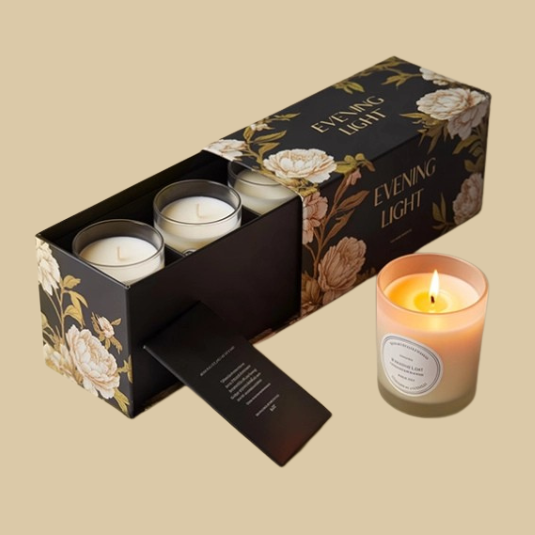
Taper candles are among the more delicate items a candle brand can ship. They’re long, thin, and just brittle enough that a bad bump can snap one in half, and even when they survive the trip, the surface can pick up scuffs, dents, and fingerprint marks that make them look used before anyone’s lit them. A good taper candle box deals with all of that quietly, which is why it’s worth understanding what’s actually going on inside one.
Why Tapers Break So Easily
The shape is the whole problem. A taper candle might be ten or twelve inches long but only about three quarters of an inch wide, which means almost all of its length is unsupported unless something’s holding it up. Pressure in the middle of a candle like that acts like a lever, and wax doesn’t flex much before it cracks. Cold weather makes it worse, because wax gets more brittle as the temperature drops, so a candle that would’ve survived a rough trip in July might snap in January.
Breakage usually shows up in three forms. Full snaps occur when a candle bends under a load or lands the wrong way in a drop. Hairline cracks are sneakier, since the candle looks fine but breaks when someone tries to put it in a holder. And then there’s bending, which happens in warm conditions when wax softens and a candle left resting at an angle slowly curves.
What a Good Box Actually Does
The main job of a taper candle box is keeping the candle straight and supported along its length, and that comes down to structure. A box that’s cut close to the candle’s length and width leaves no room to slide around, so the candle doesn’t pick up speed and slam into the end wall during transit. Flat or slightly grooved supports underneath and above hold it in place, so the weight is spread out rather than landing on a single point.
Most good taper boxes use a few things together:
- A tight length fit, so there’s only a small gap at either end
- Internal dividers or channels that keep each candle separate from its neighbors
- A sturdy board that doesn’t flex when the box is squeezed or stacked
- Wrapping or tissue around each candle to protect the surface
Dividers matter more than people realize. Candles packed together without separation rub against each other during shipping, and that friction leaves scuffs and flattened spots that can’t be fixed later. A pair of tapers in separate channels arrives looking like they just came off the mold.
Keeping the Surface Pristine
Even if a candle doesn’t break, cosmetic damage still counts. Customers buying tapers often do so for a dinner table or a wedding, so a dented or scratched candle looks like a defect. Tissue paper or a soft wrap protects against scuffing, and a clean, dry box interior keeps dust and lint from sticking to the wax. If the tapers have a glossy or dipped finish, it helps to avoid direct contact with rough cardboard and let the wrap do the touching instead.
Heat and humidity deserve a mention, too. A box that sits in a hot truck for a day can leave tapers soft enough to bend, and a damp box can leave marks on the wax surface. Choosing a sturdy board with a bit of breathing room and avoiding fully sealed plastic goes a long way toward keeping candles in good shape through a warm shipment.
Size and Count Change the Design
A box for two tapers doesn’t need the same layout as one for twelve. Small sets can usually get by with a snug sleeve or a simple tray, while larger sets benefit from a rigid box with dividers, since more candles mean more weight and more chances for movement. Length matters too. Tapers come in six-, nine-, ten-, and twelve-inch sizes, and a box built for one length won’t work well for another, so it’s worth matching the box to each size rather than stretching one design across the whole line.
Branding Without Cutting Corners
Taper candles often get sold as gifts or event pieces, which means presentation matters. Custom printing, a window cutout, or a ribbon-and-label finish can all make a box look more premium, and none of it needs to weaken the structure underneath. The important thing is to get the structure settled first and then decide on the decoration. Brands ordering larger runs often look at personalized taper candle packaging wholesale, since printing and tooling costs per box drop quickly as quantities increase, and it gives a more consistent look across the full product line.
Test With Real Candles
Spec sheets can’t tell you how a box really performs. Order a sample, load it with actual tapers, and try a few simple tests. Shake it, drop it from a couple of feet, and press gently on the lid to see how much give there is. Do it with both cold and warm candles, if you can, since wax behaves differently at each temperature. Problems that show up in a five-minute test are far cheaper to fix than those discovered after a few hundred orders have shipped.
Working With a Supplier
It helps to work with a packaging partner who understands long, narrow products, since not every box maker deals with items like this day to day. The Premier Packaging is one example of a supplier that handles custom candle boxes, and comparing a few quotes and samples from suppliers like that gives a better idea of what’s reasonable in terms of price, lead time, and build quality.
Final Thoughts
Taper candle packaging comes down to a few basics done well: a tight fit, good support along the whole length, separation between candles, and a surface wrap that keeps the wax looking clean. Get those right, and a fragile product turns into one that arrives intact, which is what customers actually remember when they open the box.


