


Introduction
In the world of automotive passion, some collectors simply acquire vehicles, while others build entire lifestyles around them. Scott Bader Los Angeles represents the latter. His property is not merely a residence filled with prized automobiles and intricate -car displays—it is a dynamic, working sanctuary dedicated to restoration, engineering, and hands-on creativity.
Inspired by a feature in Classic & Sports Car that explores the fascinating garages of devoted enthusiasts, his story reveals what happens when craftsmanship, mechanical curiosity, and nostalgia come together under one roof. The result is a space that celebrates both full-scale classic machines and the miniature racing legends that once fueled childhood dreams.
A Home Built Around Automotive Passion
For many enthusiasts, the garage is an afterthought—a storage area attached to a house. For Scott Bader Los Angeles, the garage is the heart of the property. The living space exists in harmony with the workshop areas, each complementing the other.
Classic cars line carefully organized bays, each vehicle telling a story of engineering excellence and historical significance. The property reflects thoughtful design, ensuring every project car has its place and every tool is accessible. The environment feels less like a typical home and more like a private automotive atelier.
The layout encourages productivity and inspiration. Natural light filters into workspaces, illuminating polished bodywork and partially assembled engines. It is clear that this is not a passive collection—it is an active, evolving workshop where cars are maintained, improved, and occasionally reborn.
The Allure of Classic Automobiles
Classic automobiles have a unique ability to connect generations. They embody design philosophies, mechanical innovations, and cultural moments from decades past. On this property, the selection of vehicles reflects a deep respect for craftsmanship and originality.
Rather than focusing solely on rarity or investment value, the collection emphasizes mechanical purity and driving engagement. Engines are tuned, suspensions refined, and interiors preserved with meticulous care. Each project reflects a philosophy: restoration should enhance authenticity rather than erase history.
Visitors quickly understand that these cars are not museum pieces. They are living machines, meant to be driven, heard, and experienced.
A Nostalgic World of Cars
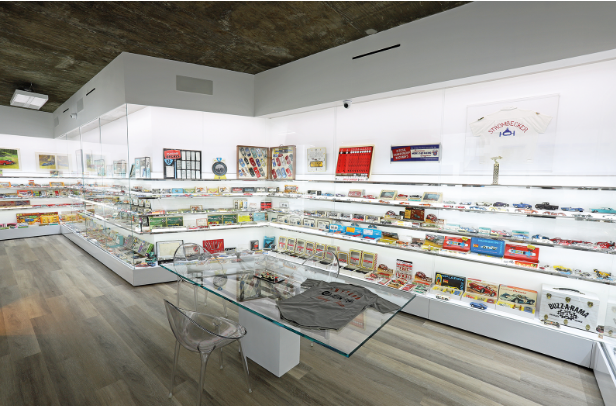
Beyond the gleaming bodywork and full-scale restorations lies another passion— cars. Carefully arranged tracks wind through dedicated display areas, evoking memories of competitive afternoons spent racing miniature versions of iconic sports cars.
The -car collection is far from casual. Tracks are engineered for smooth performance, and the cars themselves are maintained with the same attention to detail applied to their full-sized counterparts. It is a reminder that automotive enthusiasm often begins in childhood, sparked by small-scale replicas that ignite lifelong fascination.
In many ways, the slating-car world mirrors the real garage. Precision matters. Setup matters. Performance matters. The lessons learned on miniature circuits echo through the restoration bays next door.
A Fully Equipped Restoration Facility
But the property is much more than a home and automobile -car display space. A variety of rooms are used for restoration projects, with machining, engine assembly, welding and grinding, metalworking and a wood shop. He even has a CNC plasma-cutter to play with.
This professional-grade setup transforms the property into a serious restoration facility. Unlike collectors who outsource mechanical work, Scott Bader Los Angeles embraces direct involvement in every stage of the process.
Machining areas house precision tools that allow custom fabrication of components. Engine assembly benches are meticulously organized, ensuring each rebuild meets exacting standards. Welding and grinding stations enable structural repairs and bespoke modifications. The metalworking zone supports fabrication of brackets, panels, and intricate parts that are no longer commercially available.
The inclusion of a wood shop adds another dimension. Interior trim, dashboard components, and specialty cabinetry can be crafted in-house. It reflects a holistic approach to restoration—one that values craftsmanship across multiple disciplines.
The Role of Modern Technology
While the cars themselves may be decades old, the tools used to restore them incorporate modern advancements. The CNC plasma-cutter stands out as a symbol of this balance between tradition and innovation.
Computer-guided cutting ensures precision that would have been difficult to achieve in earlier eras. Complex shapes can be fabricated quickly, reducing downtime and improving fitment accuracy. Yet despite this technological advantage, the final finishing touches still depend on skilled hands.
Technology here is not about replacing craftsmanship; it enhances it.
Engineering as an Art Form
Restoring classic vehicles demands more than mechanical knowledge—it requires patience, creativity, and problem-solving. When original parts are unavailable, components must be recreated. When design flaws emerge, thoughtful improvements must be made without compromising authenticity.
In this space, engineering becomes an art form. Every bracket welded, every engine tuned, and every surface polished reflects deliberate intention.
The approach taken by Scott Bader Los Angeles illustrates how restoration can transcend hobby status. It becomes a disciplined practice, blending historical research, technical expertise, and aesthetic sensitivity.
Community and Shared Passion
Although the property functions as a private workshop, it also serves as a gathering point for fellow enthusiasts. Automotive passion thrives in community settings where ideas, techniques, and stories are exchanged.
Conversations range from carburetor tuning strategies to -car motor upgrades. Visitors leave inspired, often motivated to elevate their own projects. The environment fosters collaboration rather than competition.
Classic car culture has always relied on mentorship and shared knowledge, and this property exemplifies that spirit.
Preserving Automotive Heritage
Every restored vehicle represents a preserved piece of history. Without dedicated enthusiasts, many classic machines would disappear due to neglect or parts scarcity.
By investing time and skill into restoration projects, collectors like Scott Bader Los Angeles ensure these cars remain operational and appreciated. Preservation extends beyond aesthetics—it safeguards engineering techniques, mechanical designs, and cultural narratives from past eras.
The same philosophy applies to the -car collection. Though miniature, these racing models capture historical liveries and iconic designs, preserving memories of legendary circuits and competitions.
Balancing Precision and Play
One of the most compelling aspects of the property is its balance between serious craftsmanship and joyful recreation. The workshop areas demand concentration and technical rigor. The car tracks invite friendly competition and nostalgia.
This duality highlights an essential truth: automotive passion should be both disciplined and fun. Restoration requires focus and expertise, but the end goal remains enjoyment—whether through a spirited drive or a spirited race on a scaled-down circuit.
A Lifestyle Rooted in Craftsmanship
For many enthusiasts, cars are weekend hobbies. Here, they are woven into daily life. The property layout, equipment investment, and dedication to hands-on restoration demonstrate a lifestyle choice rather than a passing interest.
Time spent machining engine components or fine-tuning suspension geometry is not seen as labor—it is fulfillment. The tactile nature of metalworking and assembly provides a sense of accomplishment rarely found in digital pursuits.
Such dedication underscores the depth of commitment behind Scott Bader Los Angeles, transforming a residence into a creative sanctuary.
Inspiration for Future Generations
Spaces like this have the power to inspire younger enthusiasts. When children see full-scale classics alongside miniature racers, they witness the continuity of passion across generations.
Exposure to hands-on mechanical work also encourages curiosity about engineering, physics, and design. In an era dominated by automation and digital interfaces, the tangible experience of building and restoring machinery carries unique educational value.
The Bottom Line
The story of Scott Bader Los Angeles is not simply about owning classic cars or displaying car collections. It is about creating an environment where craftsmanship, innovation, and nostalgia coexist. The property stands as a testament to what happens when passion is supported by skill, tools, and unwavering dedication.
From fully equipped machining and welding rooms to precision engine assembly benches and a CNC plasma-cutter, every element reinforces a commitment to hands-on excellence. At the same time, the carefully maintained -car tracks remind visitors that automotive enthusiasm begins with imagination and play.
Ultimately, this is more than a garage—it is a living workshop, a preservation hub, and a celebration of mechanical artistry.


