

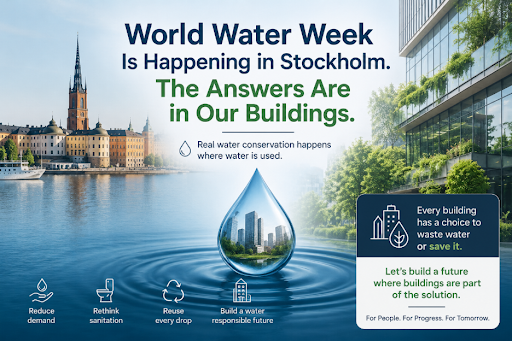
As World Water Week 2026 brings policymakers, researchers, businesses and water experts together in Stockholm around the theme “Water for People and Progress,” one question deserves to travel beyond the conference halls: where, exactly, will the water savings come from?
India’s water challenge is often discussed at the level of rivers, reservoirs, groundwater and large infrastructure. These conversations are necessary. But there is another layer of the water crisis that receives far less attention: the everyday water demand created inside our buildings.
Offices, shopping malls, hotels, hospitals, airports, educational campuses, and factories consume water continuously. Thousands of people may pass through a single building every day, and each visit can translate into water use for toilets, urinals, handwashing, cleaning and other essential activities. Multiplied across thousands of commercial buildings, these small, repeated uses have become a significant demand for already stressed urban water systems.
This is why the next chapter of water conservation cannot be only about finding more water. It must be about needing less of it in the first place. The water sector has traditionally focused heavily on the supply side: building more infrastructure, bringing water from farther away, increasing treatment capacity, and creating new sources. But supply has a limit. Demand does not disappear simply because a city builds another pipeline.
Commercial buildings therefore have a role that is both practical and strategic. They are places where water demand can be measured, redesigned, and reduced every single day. Consider something as ordinary as a urinal. Conventional urinals can use water every time they are flushed. In a busy commercial facility, that can mean thousands of liters disappearing into the drainage system simply because flushing has become the default definition of cleanliness.
Waterless urinal systems demonstrate what demand-side conservation can look like in practice. Zerodor, for example, uses a patented mechanical valve system that allows urinals to operate without flushing water, electricity, cartridges, or oil sealants. Across our installations, the impact has been particularly revealing: each waterless urinal can save more than 150,000 litres (about twice the volume of a one car garage) of water a year, depending on usage. The important lesson is not just the number of liters saved by one product. It is the principle behind it. We cannot conserve water effectively if we only ask people to use less water while leaving water-intensive systems unchanged.
Behavior matters, but infrastructure determines behavior at scale.
A facility manager should not have to depend on thousands of occupants remembering to save water every day. The building itself should make the sustainable choice easier.
This is where demand-side water policy needs to become more closely connected with building design and operations. India’s commercial building sector has enormous potential to become an active part of water policy rather than simply a consumer of municipal water.
Water efficiency should be considered alongside energy efficiency when buildings are planned, certified, renovated, and operated. Building owners should know how much water their facilities consume, where that water goes, and which uses can be eliminated or reduced without compromising hygiene. The same thinking applies beyond urinals.
Low-flow fixtures, rainwater harvesting, wastewater treatment, greywater reuse, leak detection, water-efficient cleaning practices and decentralized treatment can all contribute to reducing a building’s dependence on freshwater. But these interventions are often treated as separate sustainability initiatives rather than as part of one integrated water strategy. That shift sounds subtle. Its implications are not.
When a building reduces its freshwater demand, it also reduces pressure on municipal supply systems. When it uses less water in toilets and sanitation, it can reduce the volume of wastewater entering the drainage network. When wastewater volumes fall, treatment infrastructure can potentially operate under less pressure. And when treated water is reused for appropriate non-potable applications, the same liter can deliver value more than once.
In other words, water efficiency inside a building can have consequences far beyond the building boundary.
This is particularly important as India’s cities continue to expand. Urbanization is increasing the number of commercial spaces, institutions, and high-footfall facilities that require reliable water supplies. At the same time, many cities are already experiencing groundwater stress, seasonal shortages, and increasing competition for freshwater.
Waiting for scarcity to become an emergency before changing consumption patterns is an expensive strategy. The commercial sector has another reason to act now: water is increasingly becoming a business continuity issue.
A facility without adequate water cannot operate normally. Hotels cannot serve guests. Hospitals cannot function safely. Offices cannot maintain basic sanitation. Factories may face operational disruptions. As water availability becomes more unpredictable, reducing dependence on freshwater becomes not only an environmental responsibility but also a form of resilience.
Yet water conservation in commercial buildings is still too often approached through the lens of short-term cost. A facility manager may ask how much water-saving technology costs. A better question is how much the building will continue spending by maintaining a water-intensive system for another five, ten or twenty years.
For Zerodor, this is one of the strongest lessons from working with commercial facilities. With more than 85,000 installations and over 3.5 billion liters (about 924602000 gal) of water saved, the experience shows that water conservation can be embedded into everyday infrastructure rather than treated as an occasional campaign.
The numbers also challenge an assumption that sustainability must always involve sacrifice.
A waterless urinal does not ask an occupant to compromise on hygiene. A properly designed wastewater reuse system does not require people to use less water by hand. A leak detection system does not depend on individual behavior. Good sustainability solutions work quietly in the background.
That is the kind of water conservation India needs more of. World Water Week is valuable precisely because it brings together the people thinking about water at a systems level. But conferences can only take the conversation so far. The real test begins when those ideas return home and enter buildings, campuses, factories, and public infrastructure.
Every building has a water footprint. Every fixture contributes to it. Every liter saved at the point of use is a liter that does not need to be extracted, transported, treated, and eventually discharged.
That does not make building-level action a substitute for policy. Quite the opposite. Strong policy can make efficient buildings the norm rather than the exception. Building codes, water-performance standards, disclosure requirements, green-building frameworks, incentives and procurement policies can accelerate the transition. But policy becomes meaningful when it changes what happens on the ground.
India does not need to wait for a new water crisis to begin designing buildings differently. The infrastructure already exists. The technologies already exist. The data from thousands of installations already exists. What is needed now is a shift in mindset.
Water for people and progress cannot simply mean finding more water for growing cities. It must also mean designing cities, buildings, and businesses that can achieve more with less.
The answers to some of India’s biggest water challenges may not always be found far away, in another river basin or another mega-project. Some of them are already inside our buildings. And every day, they are either wasting water, or saving it.


