


The logo looks perfect on the presentation slide. The colors feel right, the typography is polished, and everyone in the meeting agrees that the business finally has an identity worth showing off.
Then the real work begins.
That same logo needs to fit a mobile screen, remain recognizable on a social media profile, work on printed packaging, and look appropriate across a website. The business may introduce new products, enter different markets, or discover that its customers interact with the brand in ways nobody considered during the original design presentation.
Suddenly, the question is no longer whether the logo looks good.
It is whether the identity can keep working as the business evolves.
This is one of the challenges facing companies investing in their digital presence. Creating an attractive design is one responsibility. Turning that design into a coherent, functional, and adaptable customer experience is another.
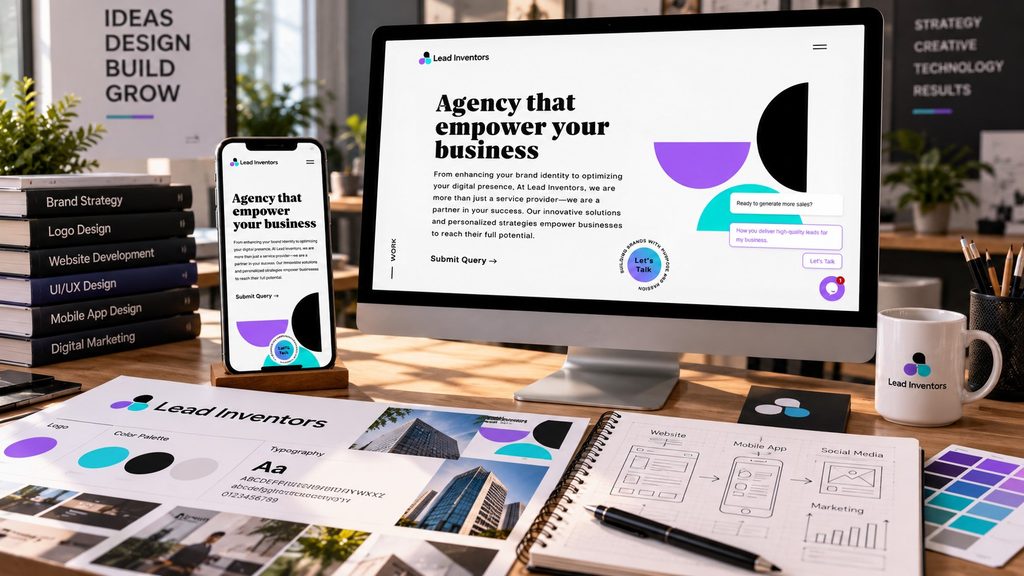
Lead Inventors, a creative agency offering branding, website design, graphic design, mobile app design, and digital marketing, positions its services around helping businesses connect these different stages of brand development.
The company’s approach reflects an important idea: creative work should not end with an attractive presentation. It should have a practical purpose beyond the moment of approval.
The Difference Between Designing a Logo and Building a Brand
A logo is often the first thing business owners think about when establishing a new company.
It is visible, recognizable, and relatively easy to imagine. Choosing a symbol or typeface can feel like the moment a business starts developing a personality.
But a visual identity extends considerably further.
A company also needs decisions about typography, colors, graphic elements, imagery, and how these components should be applied across different materials.
Without that consistency, individual designs may begin to contradict one another.
A business card might communicate sophistication, while the website feels outdated. Social media advertisements may use completely different typography. A mobile application could introduce visual elements that do not resemble the original brand.
Lead Inventors offers logo design, brand identity development, and logo modernization services intended to address different stages of this process.
Its branding offering includes creating original identities as well as refreshing established designs.
For a startup, the priority may be building a visual foundation that supports its first website and marketing materials.
For an established business, the challenge could involve modernizing an existing identity while maintaining the features customers already recognize.
The objective should not simply be to create something visually impressive.
It should be to develop an identity that remains useful wherever the business needs to communicate.
When the Brand Leaves the Design Studio
An identity can appear beautifully balanced in a digital presentation and behave differently when applied to real materials.
A detailed symbol might lose clarity at smaller sizes. A particular color combination may not reproduce consistently across print and digital media. Typography that feels expressive in a large headline may become difficult to read in a mobile interface.
These are practical design considerations, not merely aesthetic preferences.
Lead Inventors offers graphic design services covering social media creatives, marketing materials, logos, and print applications.
This range creates opportunities to think about how a brand identity moves between different formats.
A business launching a product, for example, might need packaging graphics, promotional advertisements, social media posts, and website banners.
Those designs serve different purposes, but customers should still be able to recognize the company behind them.
Achieving that consistency requires attention to scale, contrast, composition, typography, and the context in which each design will appear.
The best results are not necessarily the most elaborate.
Often, they are the ones that communicate clearly while remaining unmistakably connected to the brand.
A Website Is Where Design Meets Real Behavior
A business website introduces another dimension to the design process.
Unlike a printed poster or static logo, a website must respond to what people do.
Visitors move between pages, tap navigation menus, complete forms, compare information, and expect the experience to work across multiple screen sizes.
Lead Inventors offers custom and responsive website design, eCommerce solutions, and user experience design.
Its website services emphasize functional layouts and visual presentation that adapt to different devices.
The relationship between design and functionality matters because visual appeal alone does not guarantee a useful experience.
An attractive homepage may capture attention, but visitors still need to understand what the business offers and how to proceed.
A professional services website may need to make appointment requests straightforward. An eCommerce store should help shoppers locate products and understand their options. A portfolio website must present work without making navigation unnecessarily complicated.
These experiences involve numerous small decisions.
Where should the primary action appear? How should content be organized? Which information deserves emphasis? What changes when someone uses a phone instead of a desktop computer?
Answering those questions requires more than selecting a color palette.
It requires understanding how the intended audience will use the website.
Why User Experience Deserves a Place in the Creative Conversation
Some of the most effective digital design decisions are almost invisible.
A button appears where the visitor expects it. A form requests only the information necessary. A navigation structure makes sense without explanation.
People may not consciously notice these details when they work.
They notice when they don’t.
Lead Inventors includes UI/UX design among its principal services, with an emphasis on usability, interface clarity, visual structure, and functionality.
User interface design concerns how the interactive elements of a digital product are presented. User experience design considers the wider process of using that product, including whether the experience supports the person’s objectives.
Both require attention to actual user needs.
A visually sophisticated application can still become frustrating if its controls are confusing. A simple interface, on the other hand, may be highly effective when it makes essential actions clear.
For businesses commissioning digital products, this distinction is worth understanding.
An interface should not be judged only by how appealing it looks in a design file.
It should also be evaluated through realistic interactions, responsive behavior, and appropriate testing.
Mobile Applications Need More Than a Smaller Website
The growing role of mobile devices creates additional design considerations.
Customers may interact with a company through mobile browsers, dedicated applications, or a combination of both.
Each experience comes with different expectations.
Lead Inventors advertises mobile application design for iOS and Android, including user interface development, prototyping, cross-platform considerations, and user-testing integration.
The company also highlights the importance of functional, user-centered mobile experiences.
A dedicated application may be appropriate for businesses that need features such as repeat customer interactions, account management, personalized content, or specialized mobile functionality.
However, an app should offer a clear benefit beyond simply reproducing a website.
People need to understand its purpose, navigate its features, and accomplish their tasks without unnecessary complexity.
Prototyping is particularly useful during this process because it allows design ideas to be explored before every feature is implemented.
A prototype can help reveal confusing interactions, missing steps, or assumptions that should be reconsidered.
That feedback can be more valuable than discovering the same problems after development is substantially complete.
The Client’s Feedback Is Part of the Design Process
Creative work often begins with an idea, but the first version is rarely the final answer.
A designer may develop a direction based on a project brief, only to discover through client feedback that an important audience requirement has been overlooked.
An interface might need clearer navigation. A logo may require adjustments for particular applications. A marketing design could benefit from a more direct message.
Lead Inventors describes a five-stage process beginning with project initiation and research, followed by design execution, client feedback and approval, and project delivery.
The inclusion of feedback as a distinct stage reflects the collaborative nature of creative development.
Effective feedback is not necessarily about choosing whichever design someone personally prefers.
It is about evaluating whether the work supports the objectives established at the beginning.
For example, a business owner may favor a visually complex logo, while the designer identifies problems with readability at small sizes.
A useful review process allows those concerns to be discussed before the design is finalized.
Clear communication can also reduce avoidable revisions, misunderstandings, and inconsistent expectations.
Ultimately, the goal is not simply to obtain approval.
It is to arrive at a design that is appropriate for the business and practical to implement.
What Happens After the Project Is Delivered?
There is a reason the launch of a new website or brand identity can feel like a finish line.
The files have been delivered. The website is live. The marketing materials are ready.
But businesses rarely remain unchanged after those milestones.
New services are introduced. Customer preferences shift. Companies expand into different markets. Social platforms update their formats, and websites require new content.
A visual identity that served a business during its first year may need additional applications as the organization develops.
On its About page, Lead Inventors emphasizes ongoing brand care rather than viewing creative work solely as a completed project.
It also describes scalable services intended to accommodate businesses at different stages of development.
This is an important part of the agency’s stated positioning.
However, continuing support should always be understood in the context of the actual services and contractual arrangements selected.
For business owners, the broader lesson is that a brand needs to remain adaptable.
Design systems should make it possible to create new materials without reinventing the visual identity each time. Websites should be manageable as information changes. Marketing strategies should be reviewed as audiences and priorities develop.
A successful initial launch provides a foundation.
What happens afterward determines how useful that foundation remains.
Digital Marketing Connects the Brand With Its Audience
Once a business has developed its identity and online presence, another challenge emerges: reaching the people who might benefit from its products or services.
Lead Inventors offers digital marketing services centered on social media strategy, content creation, advertising, and community engagement.
These services complement its design capabilities by addressing how businesses communicate with audiences over time.
A well-designed logo can establish recognition, but people still need meaningful reasons to engage with the business.
A social media campaign might introduce a new service. Educational content can answer questions from potential customers. Advertising may help present a relevant offer to a defined audience.
The effectiveness of these activities depends partly on whether the message is appropriate for the people receiving it.
Different businesses require different approaches.
An emerging consumer brand may prioritize product awareness, while a professional services firm might focus on explaining its expertise.
There is no universally effective campaign format.
Branding provides the visual and communication foundation. Marketing determines how that foundation is used to connect with the intended audience.
Creative Services Should Work Together, Not Compete for Attention
One of the practical advantages of a broad creative service offering is the opportunity to consider several business needs within a connected plan.
Lead Inventors combines web design, branding, graphic design, UI/UX, mobile application design, and digital marketing.
These activities are closely related, even though each requires different technical and creative skills.
A new company might begin with a brand identity and website. Later, it may require advertising materials, an online store, or a dedicated application.
An established company could start with a website redesign and discover that its broader visual identity needs refinement.
In either situation, the most useful approach is to identify the actual business requirement before selecting the creative solution.
Not every company needs a mobile application. Not every brand requires an extensive redesign. And not every marketing challenge can be solved through new visual materials.
The purpose of creative expertise is to identify what is needed, develop an appropriate response, and ensure that the individual pieces work together.
The Real Test Begins When People Start Using the Brand
A brand identity can receive enthusiastic feedback in a design presentation. A website can look impressive in a portfolio. A mobile application can appear polished in a prototype.
But the more demanding test begins when those creations become part of everyday business activity.
Customers must recognize the brand. Visitors need to understand the website. App users should be able to complete their tasks. Promotional materials have to communicate effectively in the environments where they actually appear.
Through its combination of branding, web design, UI/UX, mobile app design, graphic design, and digital marketing, Lead Inventors presents a service model intended to connect creative execution with these practical responsibilities.
Its emphasis on client feedback and longer-term brand development reinforces the distinction between completing a design and building something a business can continue using.
The approval of a logo may be an exciting milestone. But the real achievement is creating an identity that still makes sense when the presentation is over, the business is operating, and customers begin interacting with it.
That is when a design stops being a concept and starts becoming part of the business itself.
Explore Lead Inventors: https://leadinventors.com/


