

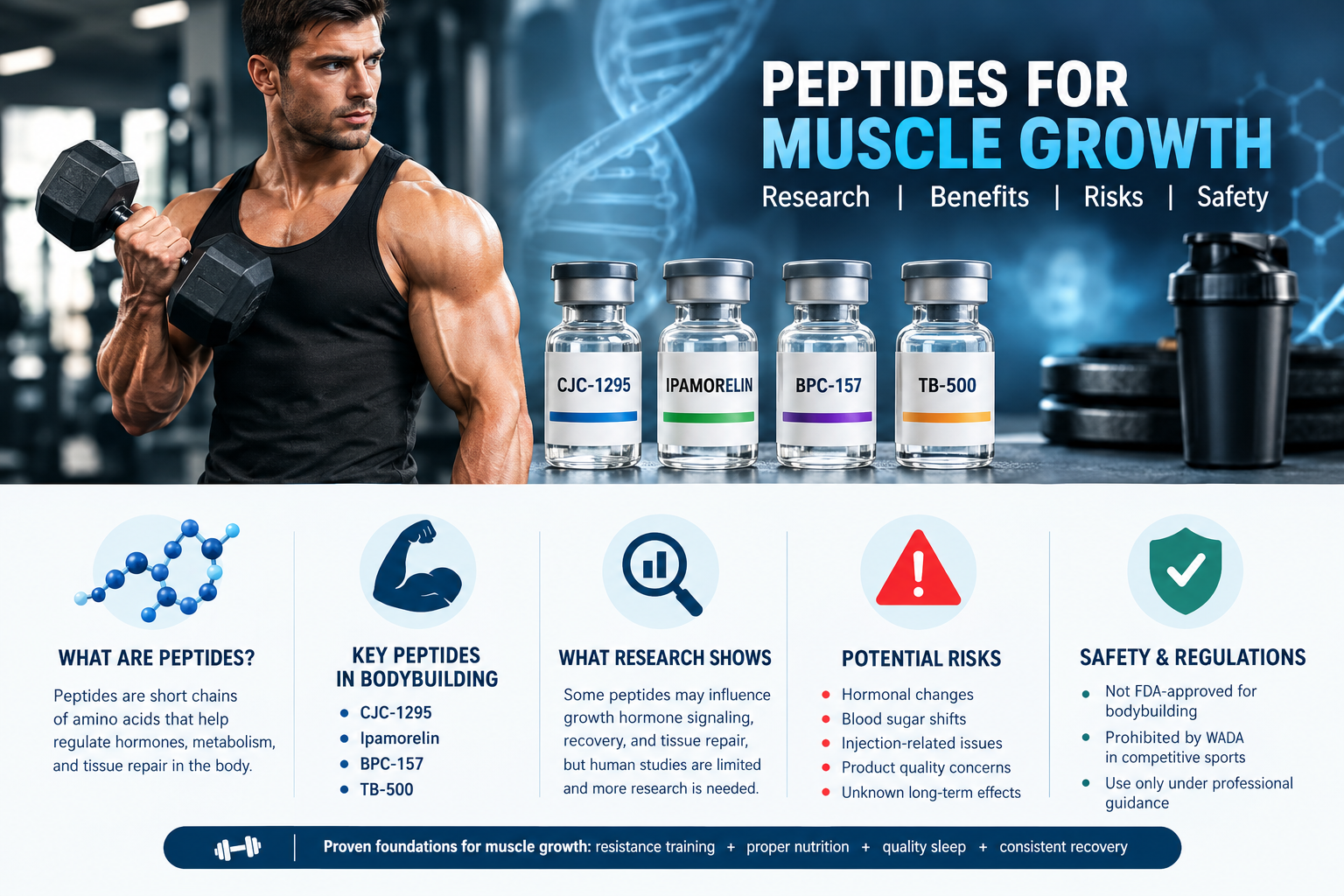
Muscle development depends on consistent resistance training, proper nutrition, and adequate recovery. However, scientific interest in peptides has introduced new questions about how amino acid chains influence growth hormone signaling, cellular activity, and tissue biology. As a result, peptides for bodybuilding have become a widely discussed subject among fitness enthusiasts and researchers.
Although certain peptides show biological activity in laboratory studies, their effects on human muscle growth and athletic performance remain uncertain. Understanding their mechanisms, research limitations, and safety considerations is essential before drawing conclusions about their potential applications.
Understanding Peptides and Their Role in Bodybuilding Research
Peptides are short chains of amino acids connected by peptide bonds. The body naturally produces many peptides that participate in hormonal signaling, metabolism, immune responses, and other biological processes.
In bodybuilding-related research, scientists examine different compounds to understand how they interact with specific receptors and cellular pathways. Some compounds receive attention because they influence growth hormone release, while others appear in studies involving tissue remodeling and cellular repair.
These categories serve different research purposes. A compound that affects hormone secretion does not necessarily improve muscle strength, and a peptide investigated in tissue models does not automatically accelerate recovery in humans.
For a broader overview of these compounds, read Hotspan’s guide to peptides for bodybuilding.
How Growth Hormone Signaling Relates to Muscle Development
Growth hormone (GH) and insulin-like growth factor 1 (IGF-1) contribute to several physiological processes, including growth, metabolism, and tissue maintenance. Researchers investigate compounds that influence these pathways to understand their biological effects.
Growth hormone secretagogues stimulate growth hormone release through specific receptor pathways. Two frequently discussed examples are CJC-1295 and ipamorelin.
CJC-1295 acts as a growth hormone-releasing hormone analog, while ipamorelin activates the ghrelin receptor associated with growth hormone secretion. Researchers study their respective mechanisms to understand changes in hormonal activity.
However, changes in hormone levels do not establish that a compound increases muscle size, improves strength, or reduces recovery time. Those outcomes require dedicated human trials that measure actual performance and body composition rather than relying exclusively on biological markers.
Peptides Commonly Investigated in Fitness Research
Several peptides appear frequently in discussions about muscle development and recovery. Their research backgrounds and limitations differ.
CJC-1295 and Ipamorelin
Researchers study CJC-1295 and ipamorelin because they influence growth hormone signaling through different mechanisms. CJC-1295 has been investigated for its effects on growth hormone and IGF-1 levels, while ipamorelin has been examined for its growth hormone-releasing activity.
Hotspan provides additional information about the compounds in its CJC-1295 Ipamorelin research listing.
Early findings involving hormonal changes should not be interpreted as proof of increased muscle mass or improved athletic performance. More research is needed to establish meaningful benefits and long-term safety in healthy adults.
BPC-157 and Tissue Research
BPC-157 is an experimental peptide studied in preclinical models involving cellular signaling and tissue-related processes. Researchers have investigated its activity in various laboratory and animal models, including those examining musculoskeletal tissues.
These findings have contributed to interest in its possible biological applications. Nevertheless, controlled human evidence remains inadequate to establish whether BPC-157 improves sports recovery, repairs injuries, or supports muscle growth.
Readers interested in its research background can review the BPC-157 research product page. Product descriptions and laboratory findings should not be treated as evidence of an established medical treatment.
TB-500 and Cellular Mechanisms
TB-500 is associated with research involving thymosin beta-4-related biology, including actin dynamics and cellular movement. These processes are relevant to investigations of tissue remodeling and cell behavior.
However, laboratory findings do not establish that TB-500 accelerates recovery from exercise or treats sports injuries in humans.
Hotspan’s TB-500 research information provides additional context about the compound’s laboratory research focus.
What Does the Available Evidence Actually Show?
The strength of evidence depends on the compound and the type of study. Researchers may investigate receptor activity in cell cultures, examine biological responses in animals, or conduct controlled trials involving human participants.
Each research method answers different questions. Cell studies help identify possible mechanisms, while animal studies provide additional preclinical information. Human clinical trials are necessary to determine whether those findings translate into meaningful benefits and acceptable safety outcomes.
For example, a change in growth hormone concentration does not prove that a person will gain more muscle. Similarly, observations involving tissue-related pathways in animals cannot establish that an experimental peptide repairs human injuries.
Hotspan’s article on peptides for muscle growth and fat loss provides further discussion of the differences between research findings and established outcomes.
Safety Considerations and Regulatory Status
Peptides marketed for bodybuilding may present uncertainties related to biological activity, product identity, purity, contamination, and long-term effects. The risks vary by compound and formulation, and limited human research makes some potential complications difficult to assess.
Important considerations include:
- Hormonal effects: Compounds affecting growth hormone pathways may influence endocrine function and other metabolic processes.
- Glucose regulation: Changes in hormonal signaling may affect blood sugar control.
- Product quality: Incorrect labeling, impurities, or contamination can create additional risks.
- Unknown long-term outcomes: Limited clinical evidence prevents reliable conclusions about prolonged exposure.
- Injection-related complications: Injectable substances can introduce risks associated with contamination, infection, and local reactions.
Regulatory status also matters. A compound’s availability online does not establish FDA approval or demonstrate that it is suitable for human use. Hotspan identifies its research products as intended for in vitro laboratory experimentation, not human consumption or therapeutic application.
Competitive athletes should also consult the current World Anti-Doping Agency (WADA) Prohibited List and their sport’s governing body. Various growth hormone secretagogues and related substances are prohibited in tested sports.
Evidence-Based Approaches to Building Muscle
Despite growing interest in experimental compounds, established training and nutrition practices remain central to muscle development.
Follow Progressive Resistance Training
A structured program that gradually increases training demands helps support improvements in strength and muscle size. Training volume, exercise selection, technique, and recovery should reflect individual ability and goals.
Meet Protein and Energy Requirements
Adequate dietary protein provides amino acids for muscle protein synthesis. Sufficient total energy intake also supports training performance and recovery. Individual requirements depend on body weight, activity level, and personal goals.
Prioritize Sleep and Recovery
Sleep supports normal physiological function and helps maintain training performance. Allowing sufficient recovery between demanding sessions can also help manage fatigue.
Track Measurable Results
Monitor training loads, repetitions, strength progression, and body composition over time. Objective measurements provide a more useful picture of progress than unsupported claims about rapid muscle growth.
Conclusion
Peptides for bodybuilding remain an important subject in experimental research because some compounds influence growth hormone signaling, cellular activity, or tissue-related pathways. CJC-1295, ipamorelin, BPC-157, and TB-500 illustrate the different research questions scientists investigate.
However, biological activity does not establish real-world effectiveness. Evidence supporting muscle growth, improved athletic performance, and faster recovery remains limited for many of these compounds, while important safety questions remain unanswered.
Readers should distinguish laboratory findings from proven human outcomes and consider regulatory requirements before interpreting claims about peptide research. Consistent resistance training, adequate nutrition, and sufficient recovery remain established foundations for sustainable muscle development.
Research disclaimer: This article is for educational purposes only and does not constitute medical advice. Hotspan research products are intended for laboratory research use only, not human consumption or therapeutic application.


